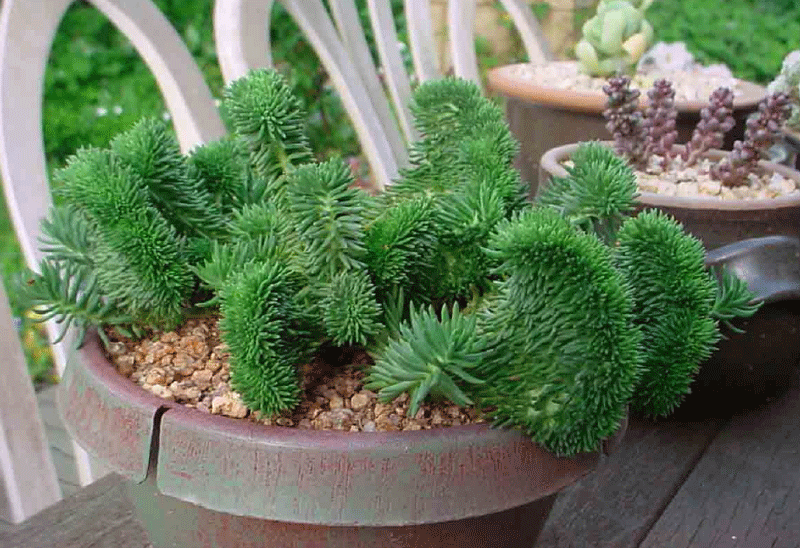
FORSTERIANUM (Sm.) Grulich, 1984
Synonyms :
Sedum rupestre L. (1753) in part / Sedum reflexum var. rupestre (L.) Grenier & Godron nom. incorr. (1848)
Sedum forsterianum Smith (1802) / Sedum rupestre ssp. forsterianum (Smith) R.L.Evans (1983) nom. inval. / Petrosedum forsterianum (Smith) Grulich (1984)
Sedum elegans Lejeune (1811) / Sedum rupestre ssp. elegans (Lejeune) Hegi & Em.Schmid (1922) / Petrosedum rupestre ssp. elegans (Lejeune) Velayos (1989)
Sedum aureum Wirtgen ex Schultz (1844) / Sedum reflexum var. aureum (Schultz) H.Jacobsen (1973)
Sedum lejeunianum Hornung ex W.D.J.Koch (1857)
Sedum trevirense Rosbach (1857)
Sedum juranum Gay (1863)
Petrosedum rupestre (L.) P.V.Heath var. forsterianum (Sm.) Niederle comb. nov. (2014)
Distribution : Western Europe. Type locality: U.K., Wales, Cardiganshire, at the Rhydoll Falls, near the Devil's Bridge.
Description (according to Praeger, Evans and IHSP) :
Perennials with non-flowering branches procumbent, rooting, with more or less flattened leaves aggregated into terminal loose cone-like rosettes, more or less adnate to the stem at their their bases.
Leaves alternate, glabrous, 10-15mm long, green or glaucous, elliptic in section, acute and mucronate at the tips, and bearing a short spur at their base, most prominent on the bracteoles. Dead leaves persisting.
Inflorescence : Terminal, erect, 20 - 30 cm long, topped with an umbellate cyme of c.5 forked & recurved branches, drooping & globose when in bud, glabrous throughout. Bracteoles like the leaves, but reducing in size upwards.
Flowers stellate, mostly 5-7 partite, rarely up to 9-merous, on short pedicels. Sepals 2-3 mm long, green, more or less triangular, united at their bases but nearly free, only slightly fleshy, persistent in fruit. Petals free, spreading, oblong-lanceolate, yellow, 6 - 7 mm long. Stamens spreading, of similar length to the petals, yellow, with yellow anthers. Nectar scales yellowish green. Carpels erect, yellowish brown.
Close to and most frequently confused with Petrosedum rupestre (L.) P.V.Heath, which is distinguished in having terete leaves, reflexed at their base, not persisting, and not crowded towards the stem apices; the inflorescence is smaller with only 3-5 branches. P. rupestre has a more east European distribution, but they overlap in France.
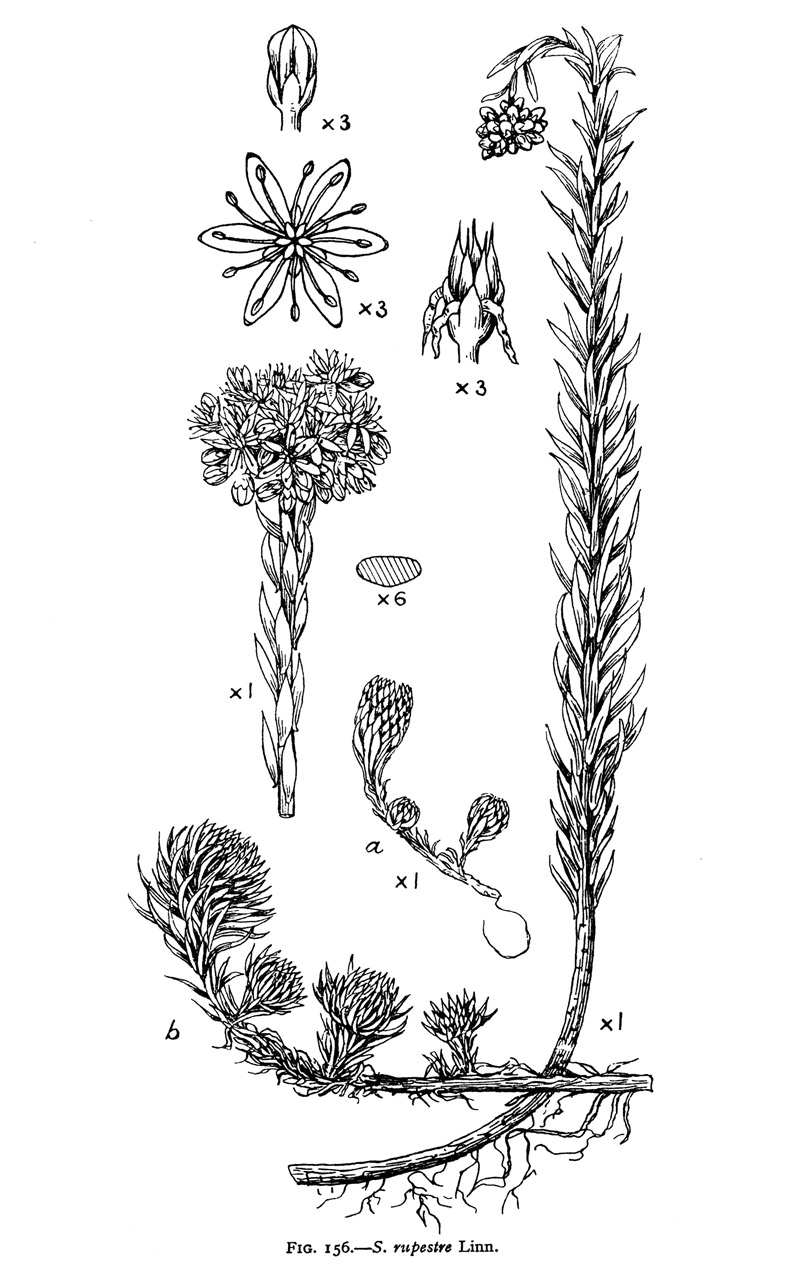
Petrosedum forsterianum. From Praeger, Account of the genus Sedum as found in cultivation, Journal of the Royal Horticultural Society 46: 266, t.156. 1921. [as rupestre]
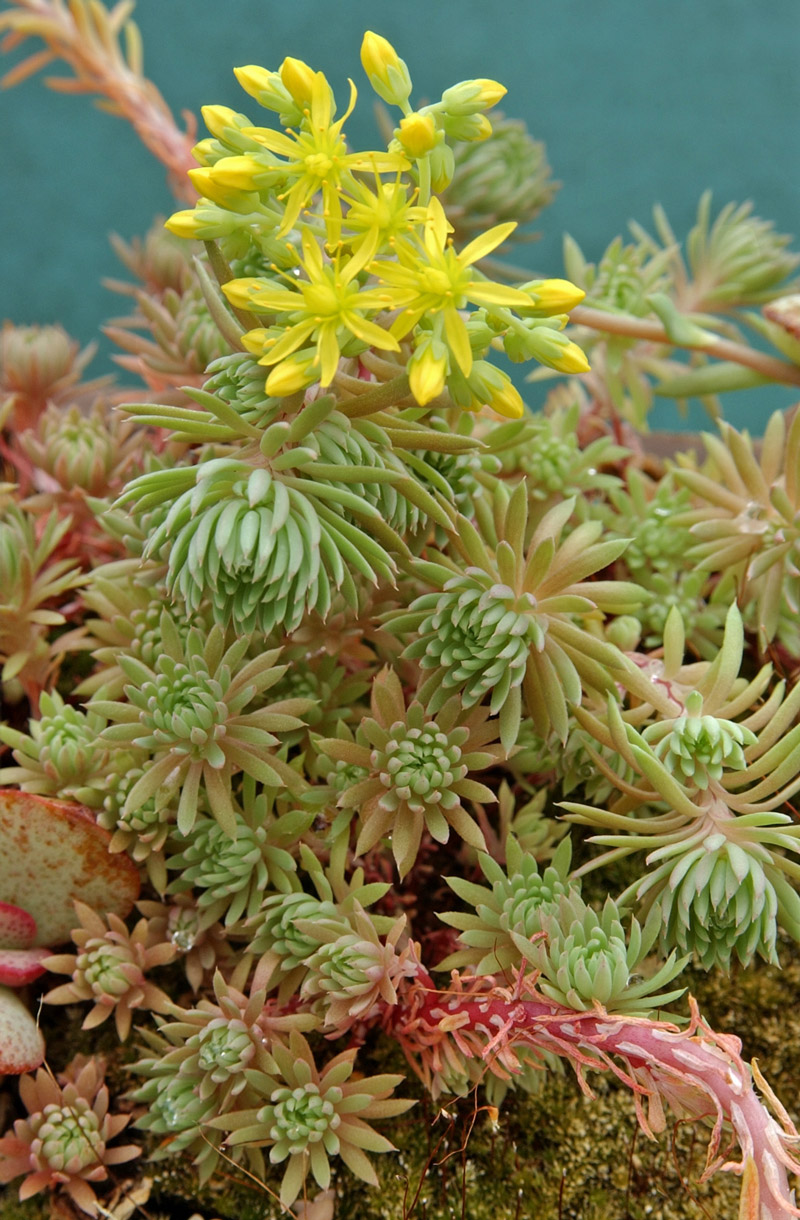
Petrosedum forsterianum 28 May 2004. Leaves to 1.5cm. long. Inflorescence 22cm. long. Flowers 1.5cm. diam.
Photo Roy Mottram
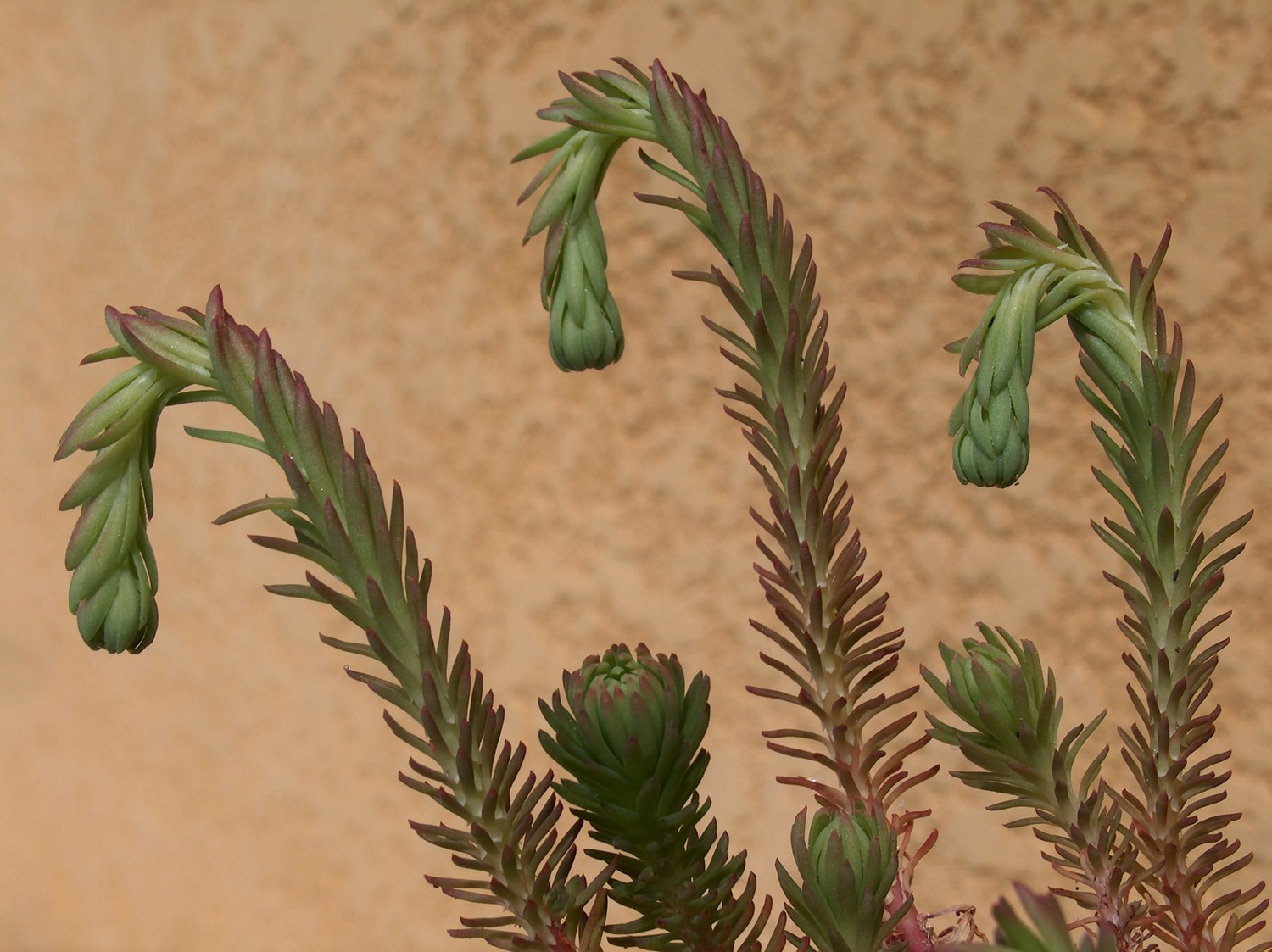
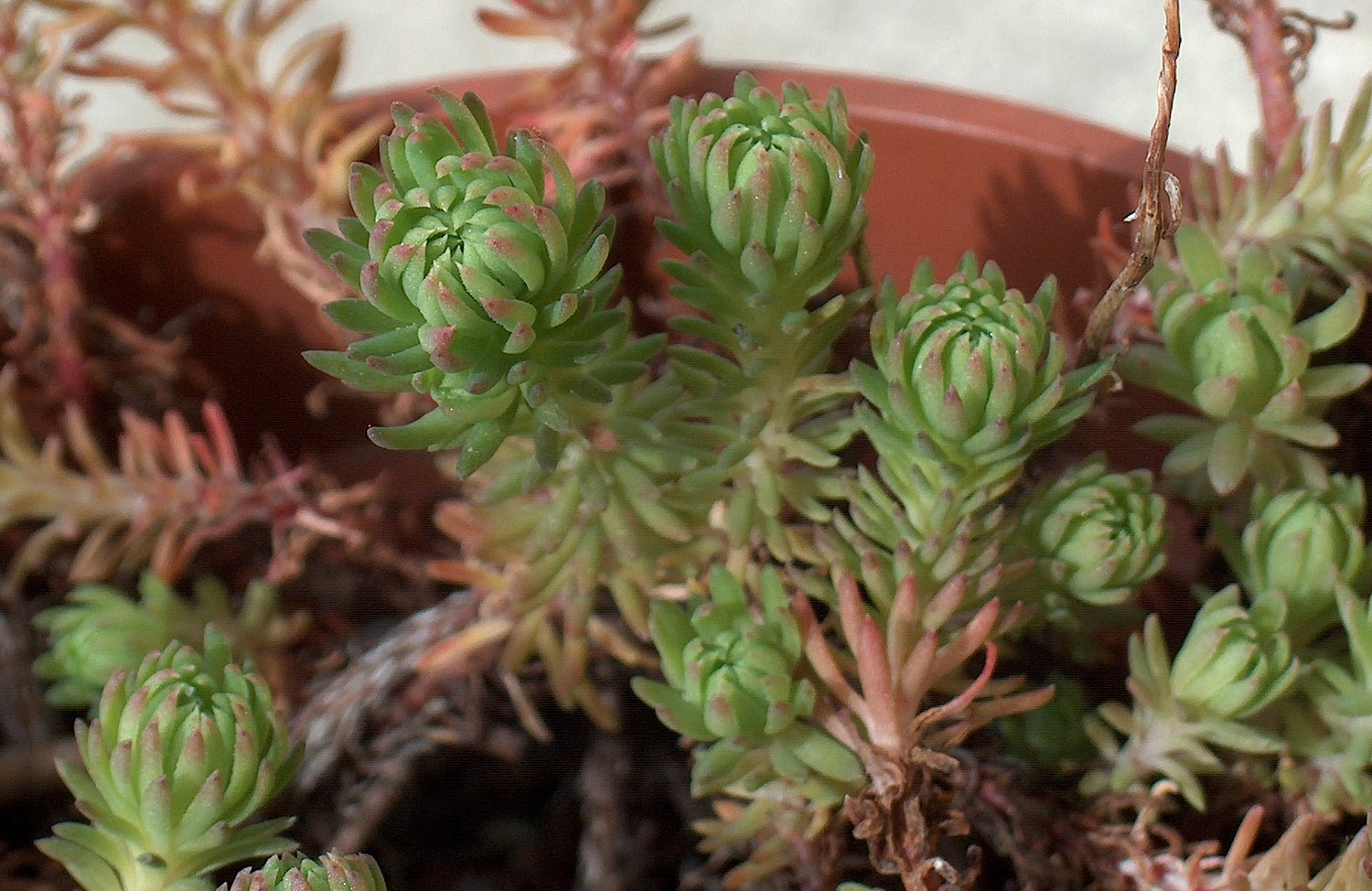
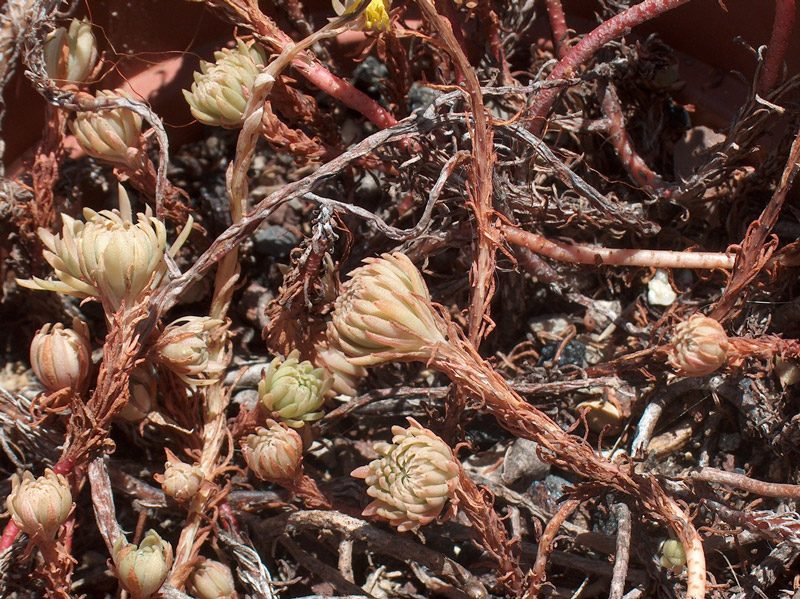
Plant in cultivation (collected by Carlos Jiménez, Villablino, León, Spain), April 2012 :
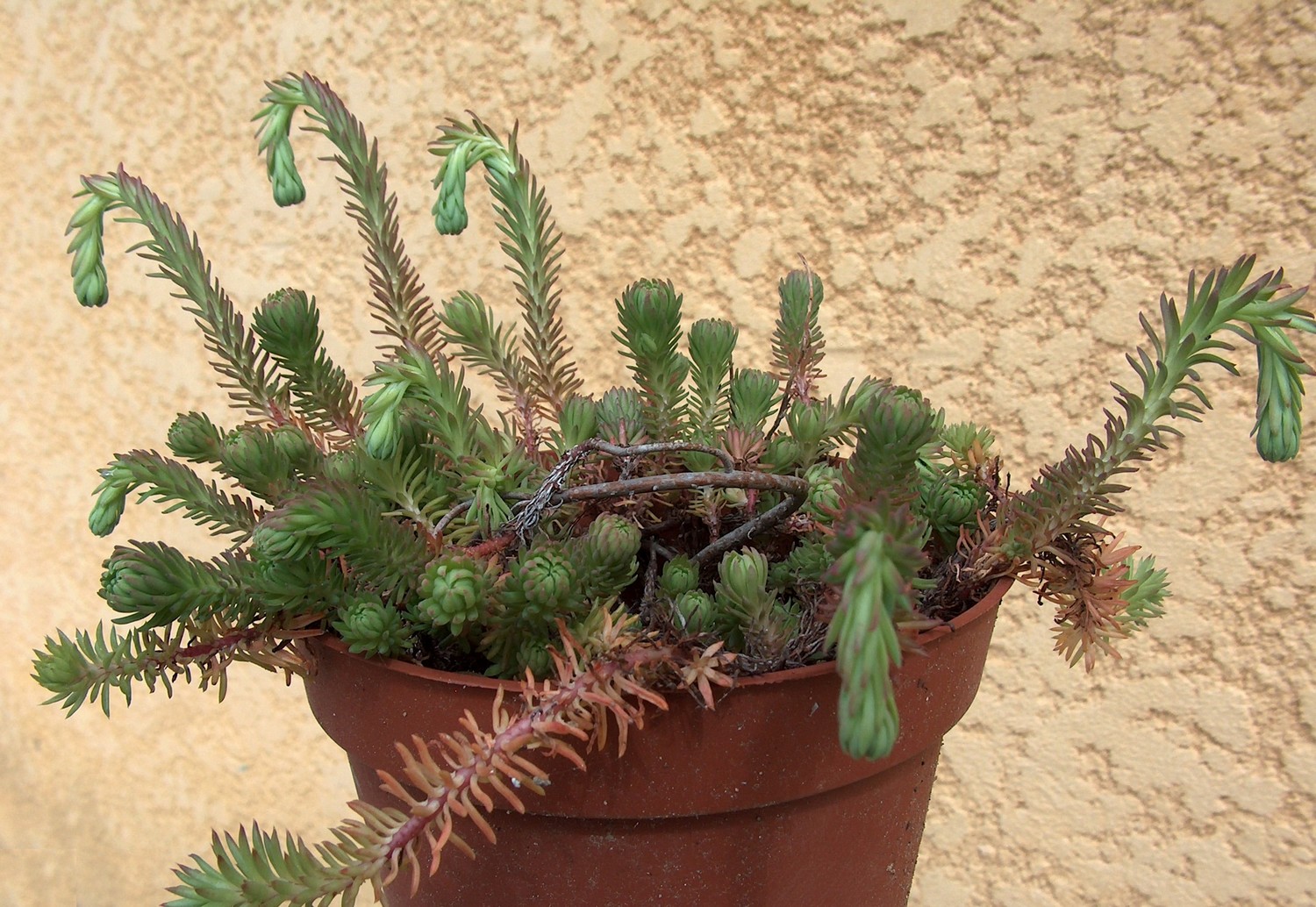
A crested plant :